
Paper trading is a simulation. It is useful for checking setup and order handling, but its fills can differ from live execution. Compare contract, data, and order settings without treating a paper result as a live-fill promise.
Educational software guidance. Trading involves risk. Read the financial and information disclaimers.
Step by step
- 1 Confirm the paper and live comparisons use the same contract and order attributes.
- 2 Check whether each session receives the same data type.
- 3 Read IBKR’s paper-trading limitations for the order type involved.
- 4 Use paper results to check message flow, account routing, and basic order behavior.
- 5 Record execution differences separately from setup failures.
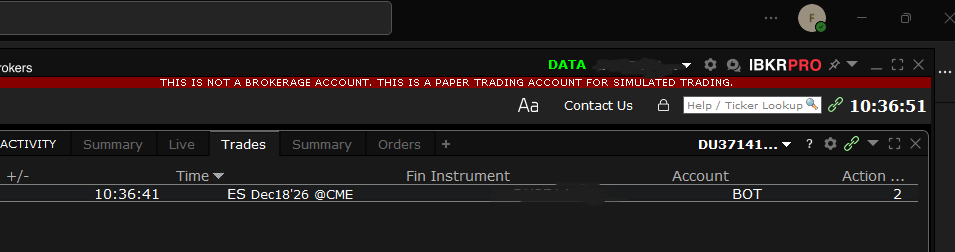
The Trades tab in the paper session records each execution with its time, instrument and action, so differences can be noted separately.
A practical example
A paper limit fills quickly, while a similar live order waits. That does not by itself show that the live setup is broken. Paper trading models fills; live trading depends on the real order book and route. Use paper to check which account, symbol, size, and exit orders the app sends. Keep a separate note for what the test did not prove, such as the price or speed of a future live fill.
Screen reference
Mistake to avoid
Common questions
Can paper test whether an alert reaches TWS?
Yes, with broker-side evidence of the intended paper order.
Does a paper stop fill prove a live exit price?
No. Live liquidity, routing, and market movement remain needed.