
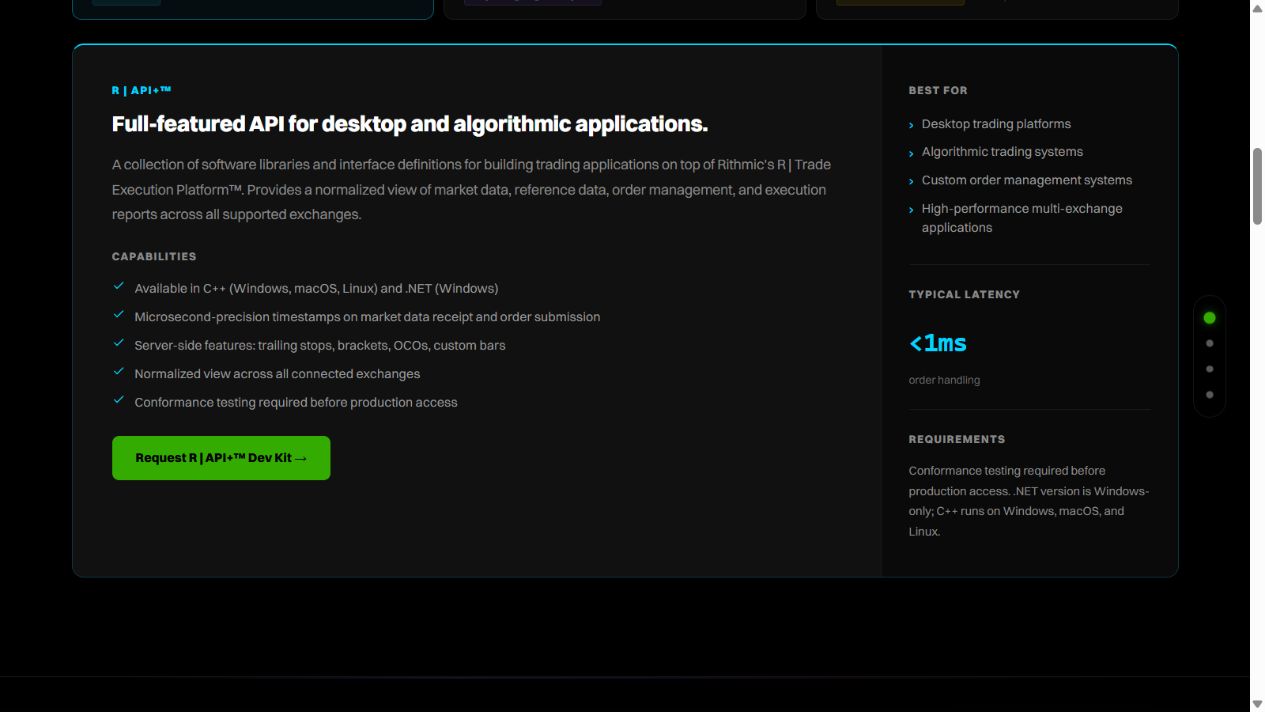
Rithmic offers R | API+, R | Protocol API and R | Diamond API for different development environments. Obtain the matching kit and current connection specification from Rithmic. Developer-test access, production conformance, account credentials and provider permission are separate requirements. A desktop login or ordinary paper demo does not establish permission to run a custom API application.
Educational software guidance. Trading involves risk. Read the financial and information disclaimers.
Compare the interface families
The official API page describes:
| Family | Interface/deployment distinction |
|---|---|
| R | API+ | C++ and .NET library interfaces; check the kit's OS support |
| R | Protocol API | Wire protocol using WebSockets and Protocol Buffers for clients in different languages |
| R | Diamond API | Specialized Linux C/C++ and co-location workflow with additional access prerequisites |
An API is the interface a program uses to request data or order actions. Protocol Buffers describe structured messages; they are not the same as a generic JSON webhook. Co-location places computing resources in a specified infrastructure environment; it is not automatically the same as an ordinary retail VPS.
Start with access requirements
- Describe the application's purpose, language and intended deployment to Rithmic.
- Obtain the appropriate current kit and test-environment instructions. Do not invent endpoints or copy a historical configuration into production.
- Develop and validate against the environment approved for that kit.
- Confirm the conformance process before production access. Conformance is the vendor's integration review; it is not an investment-performance approval.
- Obtain provider-issued account credentials and confirm market-data, session and account entitlements separately.
- Confirm fees and any provider/firm restrictions for the specific use before committing to the workflow.
Rithmic's API inquiry page distinguishes Protocol onboarding from other kit requests and states additional gating for Diamond. Follow those current instructions rather than assuming the three interfaces have identical enrollment.
Test is not the same as a paper demo
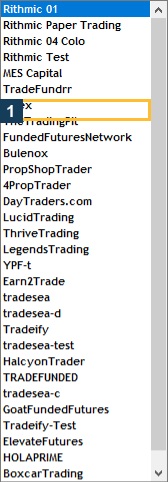
The desktop System menu contained Rithmic Test, Rithmic Paper Trading and Rithmic 01. It was read without attempting a new login. The official FAQ states that Protocol API access is not available for paper-trading demos that include live market data. Keep that restriction separate from the API page's developer-test workflow and from a provider-issued simulation account.
What an integration must verify
Plan how the application records requests, acknowledgements, fills, rejects and cancellations. Establish recovery when the connection drops between a request and its recorded outcome. Confirm which protective functions are supported and where they run for the exact route. A marketed server-side capability does not prove that every third-party connector uses it.
Do not publish invented working code or JSON fields as the Rithmic API. Use the current kit's message definitions and controlled validation. No kit was requested, custom app registered, order sent or conformance test performed for this article.
Common questions
Is a TradingView webhook the official Rithmic API?
No. A bridge's incoming alert format is a separate interface. It may translate requests through its own supported connection.
Does my RTrader Pro login authorize custom production code?
Do not assume that. Confirm application approval, environment and provider entitlements.
Is API access free?
This guide establishes no universal price. Obtain current kit, infrastructure, provider and exchange-data fees for the actual setup.
Do vendor latency figures predict my fill speed?
No. A vendor's stated performance basis is not a measured end-to-end result for your network, application, account and order.