
Measure separate timestamps for the source event, destination submission, acknowledgement and fill. Report which interval you measured and how clocks were aligned. This library does not establish a native-copier or PickMyTrade millisecond benchmark.
Educational software guidance. Trading involves risk. Read the financial and information disclaimers.
Define the measurement
| Interval | What it can show |
|---|---|
| Source event to destination request | Replication/dispatch delay under the selected event definition |
| Destination request to acknowledgement | Acceptance response time |
| Acknowledgement to fill | Execution timing, including waiting and partial fills |
| Source fill price versus follower fill price | Fill difference; not solely caused by software delay |
Use matching order/event identifiers, timestamps with timezone and known clock precision. Clock skew can make a destination appear to precede the source. A screenshot rounded to whole seconds cannot support a sub-millisecond claim.
Collect comparable observations
Use suitable existing records or a provider-permitted demonstration. Keep contract, side, quantity, order type, account stage and session conditions with every observation. Report sample size, median, upper percentiles, extremes and failures separately; do not remove slow or rejected events to improve the headline.
For illustration only, source-to-destination intervals of 12, 18 and 90 milliseconds have a median of 18 milliseconds and a worst observed value of 90 milliseconds. These invented numbers explain reporting, not measured product performance.
Interpret carefully
An identical signal does not guarantee equal queue position, full quantity or fill price. More destinations can add load and competing orders; no parallel-dispatch architecture was verified here. A VPS affects components actually running on it, not automatically every cloud/server interval.
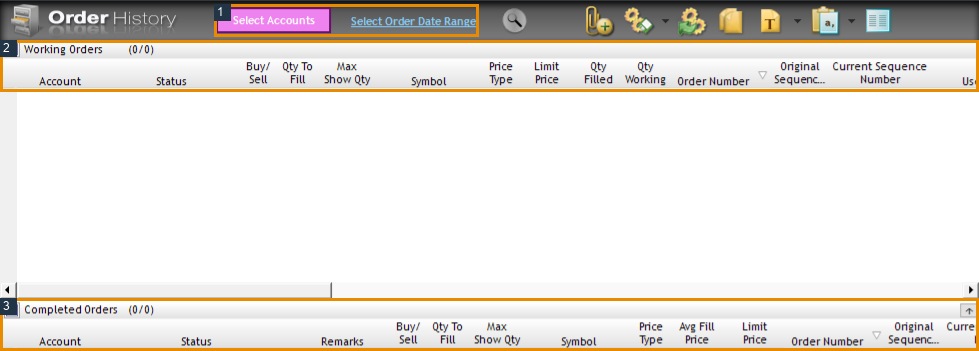
Use Rithmic order history to locate available records, and distinguish its displayed timestamps from a recipient's delivery log. The empty native history capture below identifies controls only; it is not a timing dataset.
Screenshot references
Common questions
Does a one-millisecond ping mean one-millisecond fills?
No. Network round trip and order execution are different measurements.
Does ten accounts mean exactly ten times the delay?
No universal scaling law was established. Measure the actual configuration.
Can source and follower prices differ even with low delay?
Yes. Size, queue position and market changes can affect fills.
Is the numeric example a benchmark?
No. It is explicitly illustrative arithmetic.