
MES, MNQ, MYM and M2K are smaller equity-index futures, with one-tenth the dollar multiplier of their corresponding E-mini contracts. Smaller contract size does not guarantee small losses, lower total costs or permission to trade a fixed number of micros on every prop account.
Educational software guidance. Trading involves risk. Read the financial and information disclaimers.
Four common equity micros
| Contract | Exchange | Point value | Outright tick | Tick value |
|---|---|---|---|---|
| MES | CME | $5 | 0.25 | $1.25 |
| MNQ | CME | $2 | 0.25 | $0.50 |
| MYM | CBOT | $0.50 | 1.00 | $0.50 |
| M2K | CME | $5 | 0.10 | $0.50 |
Source: CME Micro E-mini FAQ. This table covers four established equity micros; other micro energy, metal, FX and crypto products have their own specifications.
Select the actual contract
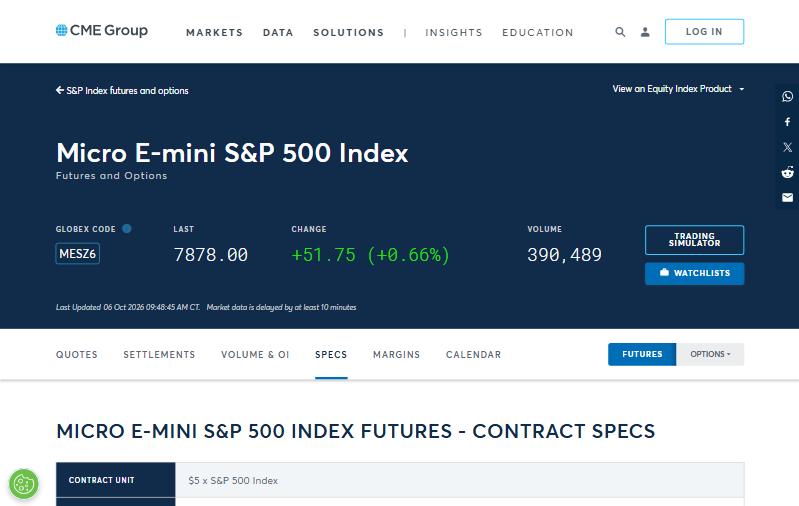
These equity micros use the quarterly March, June, September and December cycle. For a December 2026 illustration, MESZ6 identifies MES with the Z month and year suffix 6; resolve the full expiry through the platform. Use the exact exchange and format required by your connection. A continuous chart symbol is not a perpetual tradable futures contract.
Calculate exposure and costs
An illustrative 20-point move in one MES contract is $100 before costs. Ten MES have the same aggregate point exposure as one ES, but commission schedules, queue position and order limits need not be identical. Ten separately billed contracts can have materially different transaction costs from one larger contract.
Obtain current intraday/holding margin from the provider. A small advertised margin is not a maximum loss. For prop accounts, use the firm's explicit micro-equivalence and scaling rules; the economic 10:1 multiplier relationship does not automatically define its contract-count policy.
Automating a micro instrument
Select the micro in the receiving service's current generator. Check the routed root, expiry, quantity and exit units. Do not perform a text replacement from ES to MES in an unrelated payload and assume every setting scales correctly. Review the calculated dollars and the destination account limits before a permitted simulation.
Screenshot references
Common questions
Are MES and ES tick sizes different?
Both use 0.25 points outright, but MES is $1.25 per tick and ES $12.50.
Can I offset ES by buying or selling MES?
Do not assume the platform nets them. They are separate contracts with separate positions.
Does every firm count ten micros as one mini?
No. Read its current account-stage rule.
Are micros commission-free?
No. Check the actual per-side and round-trip charges.